THE GREAT PYRAMID PAPERS
The Solar System Model
PAPER U
March 2024
PAPER T
March 2024
PAPER S
March 2024
PAPER R
March 2024
PAPER Q
March 2024
PAPER P
March 2024
PAPER O
March 2024
PAPER N
September 2023
PAPER M
September 2023
The Giza Plateau
PAPER L
March 2023
PAPER K
December 2022
PAPER J
April 2022
The Great Pyramid
PAPER I
December 2021
PAPER H
April 2021
UPDATE
PAPER G
April 2021
PAPER F
April 2021
PAPER E
April 2021
PAPER D
April 2021
PAPER C
April 2021
PAPER B
April 2021
PAPER A
September 2020
BOOK 1
August 2010
Home Page
INDEX
Surveying errors within the Great Pyramid of Giza
- Surveying errors
- Understanding the plug blocks
- Optical illusions in the passages
- Resolving the upper shafts
ABSTRACT
The Great Pyramid of Giza is a well known ancient structure which has been extensively surveyed, and the
dimensions of its internal architectural features are well established. The original surveying data of the
building's architecture was published in the 1800's and the surveying of the pyramid's narrow shafts, which
was carried out between 1992 and 2013 using robotic inclinometers, was published in online documents
and CAD drawings.
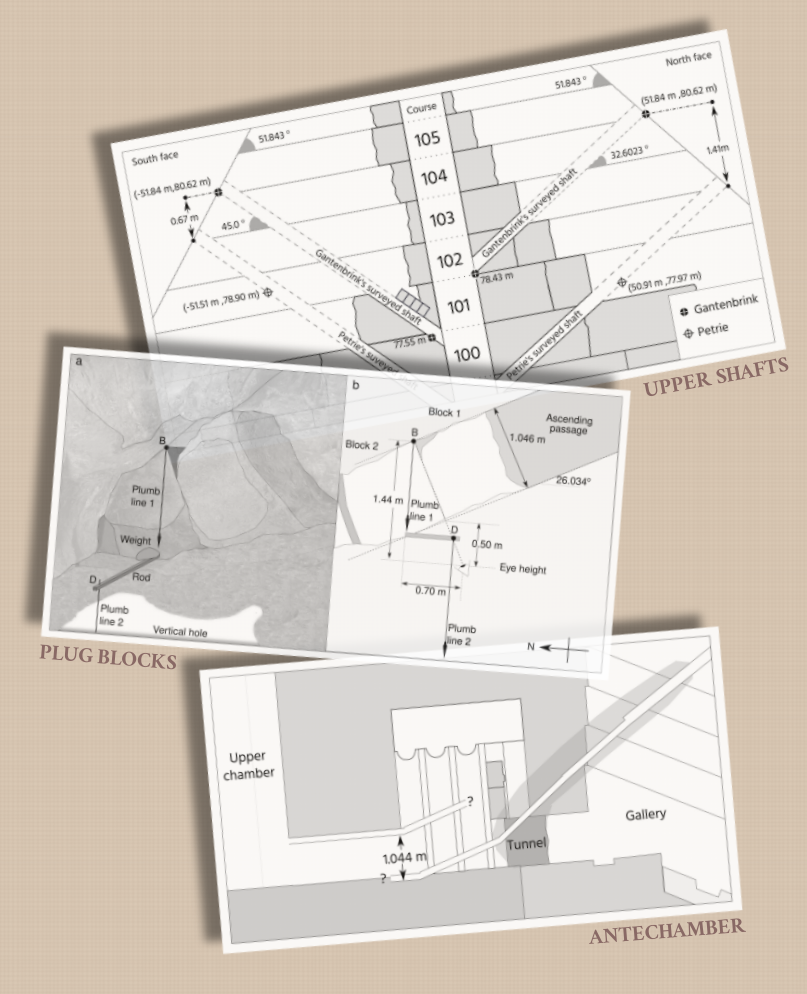
By comparing the original surveys of the pyramid, which contain details of the shafts' start and end points, with the modern robotics surveys it is determined that the two sets of data contain a vertical discrepancy of 1.4 m at the point where the upper northern shaft meets the pyramid's northern face and a vertical discrepancy of 0.67 m on the corresponding point on the south face. It is shown that these discrepancies are partially caused by a calculation error in one of the original surveys which has then been duplicated in all subsequent works, and partially by an erroneous assumption in the recent robotics survey.
By resolving the calculation error in the original survey of the building it is determined that the position of the internal architecture of the building has been incorrectly surveyed in relation to the central vertical axis of the pyramid and the ground level and that a correction to the position of the internal architecture relative to the external architecture is required.
By resolving the erroneous assumption in the modern surveying of the upper northern shaft it is determined that this shaft is not continuous from its lower to upper point and that the architecture in the lower portion of this shaft is significantly different from the currently accepted design.
 Great Pyramid Paper A - Surveying errors within the Great Pyramid of Giza
By comparing the original surveys of the pyramid, which contain details of the shafts' start and end points, with the modern robotics surveys it is determined that the two sets of data contain a vertical discrepancy of 1.4 m at the point where the upper northern shaft meets the pyramid's northern face and a vertical discrepancy of 0.67 m on the corresponding point on the south face. It is shown that these discrepancies are partially caused by a calculation error in one of the original surveys which has then been duplicated in all subsequent works, and partially by an erroneous assumption in the recent robotics survey.
By resolving the calculation error in the original survey of the building it is determined that the position of the internal architecture of the building has been incorrectly surveyed in relation to the central vertical axis of the pyramid and the ground level and that a correction to the position of the internal architecture relative to the external architecture is required.
By resolving the erroneous assumption in the modern surveying of the upper northern shaft it is determined that this shaft is not continuous from its lower to upper point and that the architecture in the lower portion of this shaft is significantly different from the currently accepted design.
DOWNLOAD THIS PAPER - 2.7 Mb
Great Pyramid Paper A - Surveying errors within the Great Pyramid of Giza

ISBN Registered and ©Copyright
The right of Stephen Brabin to be identified as the author of this work has been asserted by him in accordance with the Copyright, Designs and Patents Act of 1998 All rights reserved. No part of this publication may reproduced, stored in or introduced into a retrieval system, or transmitted , in any form, or by any means, (electronic, mechanical, photocopying, recording or otherwise) without the prior written permission of the author. Any person who does any unauthorised act to this publication may be liable to criminal prosecution and civil claims for damages.