THE GREAT PYRAMID PAPERS
The Solar System Model
PAPER U
March 2024
PAPER T
March 2024
PAPER S
March 2024
PAPER R
March 2024
PAPER Q
March 2024
PAPER P
March 2024
PAPER O
March 2024
PAPER N
September 2023
PAPER M
September 2023
The Giza Plateau
PAPER L
March 2023
PAPER K
December 2022
PAPER J
April 2022
The Great Pyramid
PAPER I
December 2021
PAPER H
April 2021
UPDATE
PAPER G
April 2021
PAPER F
April 2021
PAPER E
April 2021
PAPER D
April 2021
PAPER C
April 2021
PAPER B
April 2021
PAPER A
September 2020
BOOK 1
August 2010
Home Page
INDEX
Decoding the north and west walls of the upper chamber of the Great Pyramid
- Main chamber stone sizes
- Hidden lines on the walls
- Binary 0s and 1s on the walls
- Moving the 'coffin'
ABSTRACT
The Great Pyramid of Giza's is a well known ancient building on the outskirts of Cairo and its internal
architecture contains a series of passages, shaft and chambers. Its upper chamber, commonly known as the
King's Chamber, is constructed from polished granite blocks which are assembled with a high degree of
precision, and as a result contain horizontal and vertical wall joints with thicknesses in the submillimeter
range.
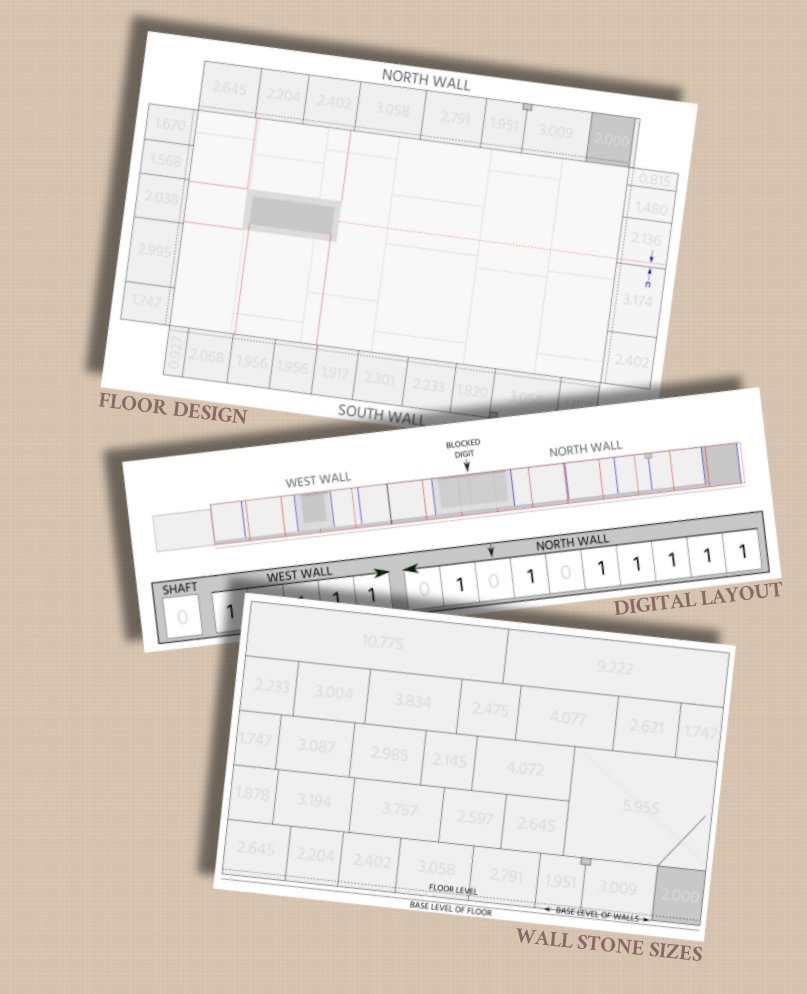
In this paper I show that the vertical joints between the granite wall blocks of the upper chamber have been designed so that they can be read as binary ones when set into a regular grid pattern of rectangles covering the wall.
I then show that this binary data is formatted in an identical manner to our contemporary IEEE 754 floating point number storage system for 16 bit computers and subsequently decode the numerical data on the chamber's north and west walls. I show that the numerical data that is extracted from the top two levels of the walls specifies the binary format of the system required to decode the numbers and then show that the decimal numbers obtained from the lower three levels of the walls describe recognisable features within the pyramid.
 Great Pyramid Paper E -Decoding the north and west walls of the upper chamber of the Great Pyramid
In this paper I show that the vertical joints between the granite wall blocks of the upper chamber have been designed so that they can be read as binary ones when set into a regular grid pattern of rectangles covering the wall.
I then show that this binary data is formatted in an identical manner to our contemporary IEEE 754 floating point number storage system for 16 bit computers and subsequently decode the numerical data on the chamber's north and west walls. I show that the numerical data that is extracted from the top two levels of the walls specifies the binary format of the system required to decode the numbers and then show that the decimal numbers obtained from the lower three levels of the walls describe recognisable features within the pyramid.
DOWNLOAD THIS PAPER - 3.1 Mb
Great Pyramid Paper E -Decoding the north and west walls of the upper chamber of the Great Pyramid

ISBN Registered and ©Copyright
The right of Stephen Brabin to be identified as the author of this work has been asserted by him in accordance with the Copyright, Designs and Patents Act of 1998 All rights reserved. No part of this publication may reproduced, stored in or introduced into a retrieval system, or transmitted , in any form, or by any means, (electronic, mechanical, photocopying, recording or otherwise) without the prior written permission of the author. Any person who does any unauthorised act to this publication may be liable to criminal prosecution and civil claims for damages.