THE GREAT PYRAMID PAPERS
The Solar System Model
PAPER U
March 2024
PAPER T
March 2024
PAPER S
March 2024
PAPER R
March 2024
PAPER Q
March 2024
PAPER P
March 2024
PAPER O
March 2024
PAPER N
September 2023
PAPER M
September 2023
The Giza Plateau
PAPER L
March 2023
PAPER K
December 2022
PAPER J
April 2022
The Great Pyramid
PAPER I
December 2021
PAPER H
April 2021
UPDATE
PAPER G
April 2021
PAPER F
April 2021
PAPER E
April 2021
PAPER D
April 2021
PAPER C
April 2021
PAPER B
April 2021
PAPER A
September 2020
BOOK 1
August 2010
Home Page
INDEX
The vertical chamber stack of the Great Pyramid part 2
- Overlapping CAD projections
- The height of the Great Pyramid
- Upper roof chamber stones
- Spot heights within the pyramid
ABSTRACT
The Great Pyramid of Giza is a well known ancient building that is located on the outskirts of Cairo. It
contains complex internal architecture which has been analysed in the previous papers in this series, and in
particular in paper B ''The vertical chamber stack of the Great Pyramid part 1" it was proven that the
upper and lower chambers of the building are stacked above each other in a logical manner which allows
the vertical location of the chambers to be deduced without the need for surveying. The vertical
architectural stack that was established in that paper terminated at the ceiling of the first of the roof
chambers above the pyramid's upper chamber and at a specific half-integer altitude above the base of the
building when measured in the architect's unit of measurement, the cubit.
In the three subsequent papers, additional information regarding the horizontal stacking, the position of the roof chambers, and the binary data contained on the upper chamber walls was discovered and documented.
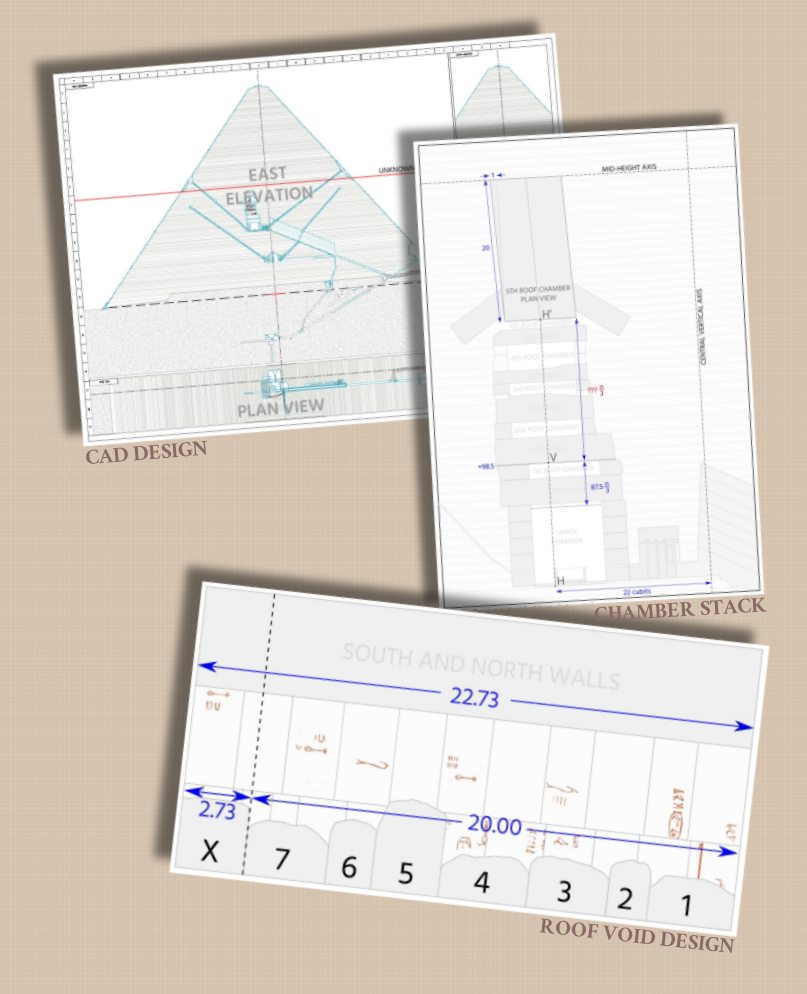
In this paper I extend the vertical stack of the architecture from the ceiling of the first roof chamber up to the mid height of the pyramid using the system that is inherent in the architecture. The information that was discovered in the previous three papers is used to continue the vertical stack in a logical manner until the point that the half height of the pyramid can be determined from a continuous series of data from the base level of the pyramid upwards.
I show that the data that is inherent in the upper portion of the pyramid's vertical stack design incorporates fundamental geodesic constants from which I deduce that the Great Pyramid must be a geometric scale model of Earth.
 Great Pyramid Paper F - The vertical chamber stack of the Great Pyramid part 2
In the three subsequent papers, additional information regarding the horizontal stacking, the position of the roof chambers, and the binary data contained on the upper chamber walls was discovered and documented.
In this paper I extend the vertical stack of the architecture from the ceiling of the first roof chamber up to the mid height of the pyramid using the system that is inherent in the architecture. The information that was discovered in the previous three papers is used to continue the vertical stack in a logical manner until the point that the half height of the pyramid can be determined from a continuous series of data from the base level of the pyramid upwards.
I show that the data that is inherent in the upper portion of the pyramid's vertical stack design incorporates fundamental geodesic constants from which I deduce that the Great Pyramid must be a geometric scale model of Earth.
DOWNLOAD THIS PAPER - 2.1 Mb
Great Pyramid Paper F - The vertical chamber stack of the Great Pyramid part 2

ISBN Registered and ©Copyright
The right of Stephen Brabin to be identified as the author of this work has been asserted by him in accordance with the Copyright, Designs and Patents Act of 1998 All rights reserved. No part of this publication may reproduced, stored in or introduced into a retrieval system, or transmitted , in any form, or by any means, (electronic, mechanical, photocopying, recording or otherwise) without the prior written permission of the author. Any person who does any unauthorised act to this publication may be liable to criminal prosecution and civil claims for damages.