THE GREAT PYRAMID PAPERS
The Solar System Model
PAPER U
March 2024
PAPER T
March 2024
PAPER S
March 2024
PAPER R
March 2024
PAPER Q
March 2024
PAPER P
March 2024
PAPER O
March 2024
PAPER N
September 2023
PAPER M
September 2023
The Giza Plateau
PAPER L
March 2023
PAPER K
December 2022
PAPER J
April 2022
The Great Pyramid
PAPER I
December 2021
PAPER H
April 2021
UPDATE
PAPER G
April 2021
PAPER F
April 2021
PAPER E
April 2021
PAPER D
April 2021
PAPER C
April 2021
PAPER B
April 2021
PAPER A
September 2020
BOOK 1
August 2010
Home Page
INDEX
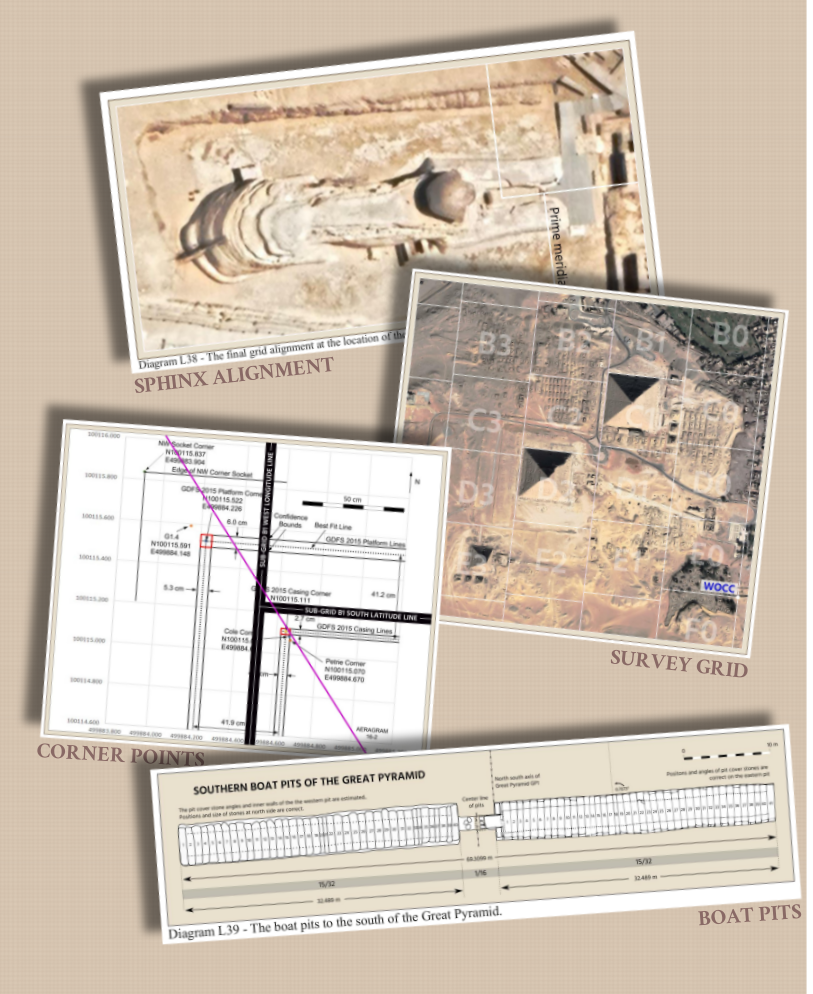
The world survey grid, prime meridian Giza
- Great Pyramid corner points
- The Giza mastaba's design
- Boat pits around the pyramid
- The second Sphinx hidden under the sand
ABSTRACT
In this paper it is proven beyond reasonable doubt that the pyramids and structures on the Giza plateau to
the west of Cairo contain a sophisticated prime meridian layout which is the baseline for a survey grid
which tessellates continuously around the world. The geometric creation of that grid is explained and it is
proven that other ancient monuments are built to align to the survey grid.
In the process of explaining the survey grid's design a series of locations on the Giza plateau are
mathematically identified which correlate to the known surveying points of the plateau to within the
tolerances of those surveys.
The coordinates of the corners of the Great Pyramid of Giza are located geometrically for the building's external stonework lines, the platform upon which it is built and for the external corners of the foundations of the building, known as the socket corners. From these corner points the azimuth of the casing sides of the pyramid are calculated and shown to agree to the surveyed value to within 0.63 of an arc second.
The boat pits that surround the Great Pyramid are resolved during the process of the analysis and are shown to contain the angular value of the tectonic plate movement of the African plate upon which the Giza plateau monuments are built. The discovery of an as yet unknown site in Egypt is explained which marks out the position of the sidereal day meridian relative to the prime meridian at Giza and it is shown that the external walls of the building at this location are a replica of the Sphinx temple's inner layout.
It is explained how the mastabas that surround the Giza pyramids have been designed to correlate to the geometric grid and the discovery is presented of the second Sphinx of Giza, which is situated to the south of the currently known statue and which is still buried under the desert sands. From this discovery the design of the Unfinished Pyramid at Zawiyet elAryan 3km south of Giza is deduced and the grid's dynamic grid rotation geometry is concluded at this location.
Finally it is shown how the grid tessellates around the world and that the principal row of statues on Easter Island at Ahu Tongariki align perfectly with the Giza grid design.


ISBN Registered and ©Copyright
The right of Stephen Brabin to be identified as the author of this work has been asserted by him in accordance with the Copyright, Designs and Patents Act of 1998 All rights reserved. No part of this publication may reproduced, stored in or introduced into a retrieval system, or transmitted , in any form, or by any means, (electronic, mechanical, photocopying, recording or otherwise) without the prior written permission of the author. Any person who does any unauthorised act to this publication may be liable to criminal prosecution and civil claims for damages.