THE GREAT PYRAMID PAPERS
The Solar System Model
PAPER U
March 2024
PAPER T
March 2024
PAPER S
March 2024
PAPER R
March 2024
PAPER Q
March 2024
PAPER P
March 2024
PAPER O
March 2024
PAPER N
September 2023
PAPER M
September 2023
The Giza Plateau
PAPER L
March 2023
PAPER K
December 2022
PAPER J
April 2022
The Great Pyramid
PAPER I
December 2021
PAPER H
April 2021
UPDATE
PAPER G
April 2021
PAPER F
April 2021
PAPER E
April 2021
PAPER D
April 2021
PAPER C
April 2021
PAPER B
April 2021
PAPER A
September 2020
BOOK 1
August 2010
Home Page
INDEX
Encoded data within the shafts and gallery of the Great Pyramid
- Radian measurements
- Encoded numerical data
- Astronomy values
- Inexplicable context
ABSTRACT
The Great Pyramid of Giza is a well known ancient monument situated on the outskirts of Cairo, Egypt.
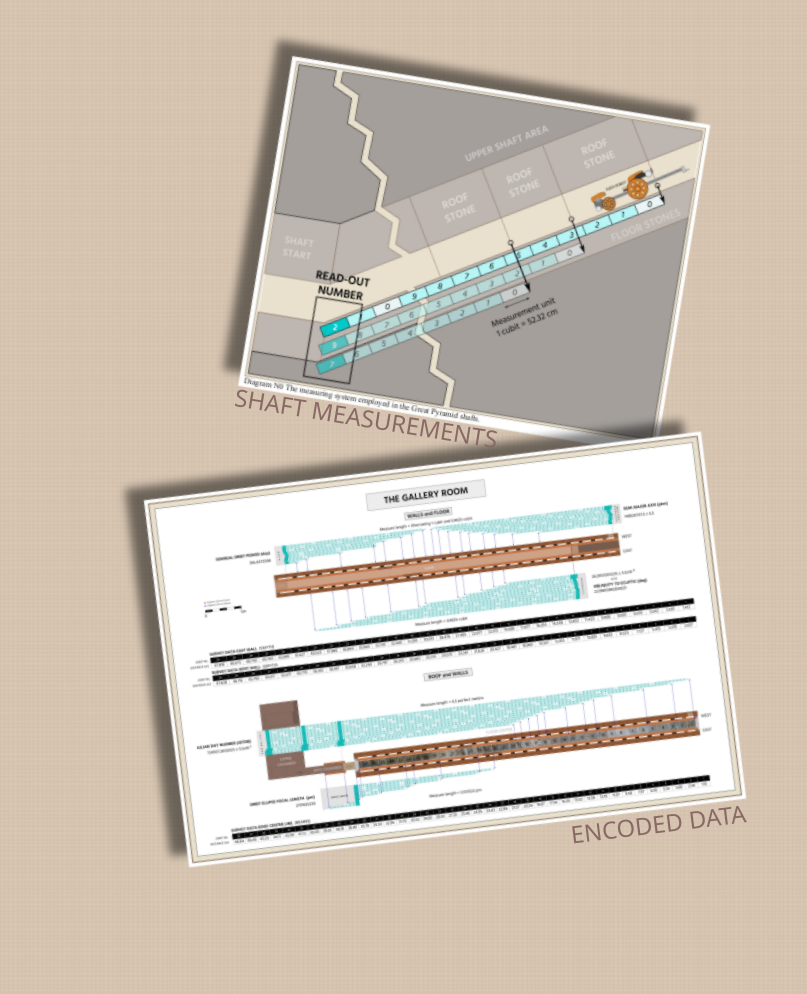
Within the building are two chambers from which four narrow square shafts are currently known to emanate. The shafts have been explored in recent times by robotic systems that were custom designed for the task and the internal stonework joints of each shaft's walls and roof has been surveyed.
The surveys show that the shaft's stonework is comprised of irregular length blocks and the reason for this has not been addressed in any of the surveying reports.
Here I show that stone's joint spacing is irregular because it encodes precision numerical data. It was found that the angles of the roof and floor of three of the shafts has been intentionally recorded in the stonework at the time of construction, in radians, and to 15 decimal places of accuracy. The stone joint's numerical descriptions of the shaft's angles were found to relate directly to a geometric system encompassing all four shafts which resulted in precision astronomical data also being extracted from the architecture which compares accurately with data from current ephemerides.
The results show that the building's architectural design is considerably more complex than currently thought and involves calculations of such an advanced scientific nature as to be able to conclude that the origins of the pyramid must be drastically different from current assumptions.
 Great Pyramid Paper N - Encoded data within the shafts and gallery of the Great Pyramid
Within the building are two chambers from which four narrow square shafts are currently known to emanate. The shafts have been explored in recent times by robotic systems that were custom designed for the task and the internal stonework joints of each shaft's walls and roof has been surveyed.
The surveys show that the shaft's stonework is comprised of irregular length blocks and the reason for this has not been addressed in any of the surveying reports.
Here I show that stone's joint spacing is irregular because it encodes precision numerical data. It was found that the angles of the roof and floor of three of the shafts has been intentionally recorded in the stonework at the time of construction, in radians, and to 15 decimal places of accuracy. The stone joint's numerical descriptions of the shaft's angles were found to relate directly to a geometric system encompassing all four shafts which resulted in precision astronomical data also being extracted from the architecture which compares accurately with data from current ephemerides.
The results show that the building's architectural design is considerably more complex than currently thought and involves calculations of such an advanced scientific nature as to be able to conclude that the origins of the pyramid must be drastically different from current assumptions.
DOWNLOAD THIS PAPER - 14.1 Mb
Great Pyramid Paper N - Encoded data within the shafts and gallery of the Great Pyramid

ISBN Registered and ©Copyright
The right of Stephen Brabin to be identified as the author of this work has been asserted by him in accordance with the Copyright, Designs and Patents Act of 1998 All rights reserved. No part of this publication may reproduced, stored in or introduced into a retrieval system, or transmitted , in any form, or by any means, (electronic, mechanical, photocopying, recording or otherwise) without the prior written permission of the author. Any person who does any unauthorised act to this publication may be liable to criminal prosecution and civil claims for damages.