THE GREAT PYRAMID PAPERS
The Solar System Model
PAPER U
March 2024
PAPER T
March 2024
PAPER S
March 2024
PAPER R
March 2024
PAPER Q
March 2024
PAPER P
March 2024
PAPER O
March 2024
PAPER N
September 2023
PAPER M
September 2023
The Giza Plateau
PAPER L
March 2023
PAPER K
December 2022
PAPER J
April 2022
The Great Pyramid
PAPER I
December 2021
PAPER H
April 2021
UPDATE
PAPER G
April 2021
PAPER F
April 2021
PAPER E
April 2021
PAPER D
April 2021
PAPER C
April 2021
PAPER B
April 2021
PAPER A
September 2020
BOOK 1
August 2010
Home Page
INDEX
The models of Mars at Makkah in an ancient solar system model
- Model of Mars
- Deimos and Phobos models
- Photograph etched into desert
- Geometrically aligned to Giza
- Survey closure in Makkah
ABSTRACT
In the earlier papers in this series a model of the inner solar system has been discovered which has located
scale models of the Moon, Earth, the Sun, Venus and Mercury. The formation geometry and location of the
remaining inner solar system planet Mars has so far not been identified.
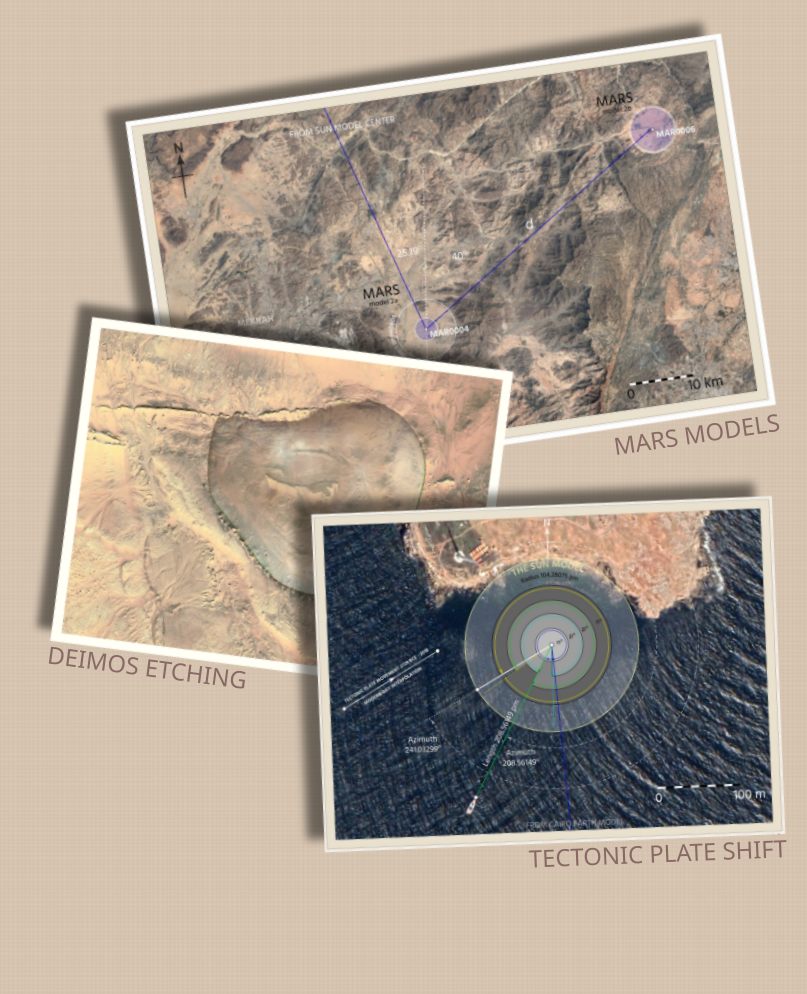
In this paper I show that there are four primary models of Mars which are paired off into two groups each containing two models, the first pair being positioned according to the scaled long term average perihelion of Mars and the second pair being positioned according to the range of the planet at the moment of the 2729 BCE winter solstice.
I show that each of the four Mars models has been built as a feature carved out of the earth rather than as a building and show that the four models form a coherent system with the same geometric features being present on each of the models. I show that the orbits of the two moons of Mars are principal parts of the constructions and identify a ground feature which is a model of the outer moon Deimos with its distinct shape used to delimit the model's perimeter.
I then show that the locations of the whole of the inner solar system model's planets and moon's forms a surveying loop which can be closed off using a logical geometric construction between the location of the model of Venus and the fourth model of Mars and that this survey closure system also attaches perfectly to one of the world's most important religious locations.
I conclude that the inner solar system model has been accurately reverse engineered and that it is a scientifically precise and pre-planned construction stretching over thousands of kilometers and connecting numerous historical and geographic features.
 Great Pyramid Paper R - The models of Mars at Makkah in an ancient solar system model
In this paper I show that there are four primary models of Mars which are paired off into two groups each containing two models, the first pair being positioned according to the scaled long term average perihelion of Mars and the second pair being positioned according to the range of the planet at the moment of the 2729 BCE winter solstice.
I show that each of the four Mars models has been built as a feature carved out of the earth rather than as a building and show that the four models form a coherent system with the same geometric features being present on each of the models. I show that the orbits of the two moons of Mars are principal parts of the constructions and identify a ground feature which is a model of the outer moon Deimos with its distinct shape used to delimit the model's perimeter.
I then show that the locations of the whole of the inner solar system model's planets and moon's forms a surveying loop which can be closed off using a logical geometric construction between the location of the model of Venus and the fourth model of Mars and that this survey closure system also attaches perfectly to one of the world's most important religious locations.
I conclude that the inner solar system model has been accurately reverse engineered and that it is a scientifically precise and pre-planned construction stretching over thousands of kilometers and connecting numerous historical and geographic features.
DOWNLOAD THIS PAPER - 8.0 Mb
Great Pyramid Paper R - The models of Mars at Makkah in an ancient solar system model

ISBN Registered and ©Copyright
The right of Stephen Brabin to be identified as the author of this work has been asserted by him in accordance with the Copyright, Designs and Patents Act of 1998 All rights reserved. No part of this publication may reproduced, stored in or introduced into a retrieval system, or transmitted , in any form, or by any means, (electronic, mechanical, photocopying, recording or otherwise) without the prior written permission of the author. Any person who does any unauthorised act to this publication may be liable to criminal prosecution and civil claims for damages.