THE GREAT PYRAMID PAPERS
The Solar System Model
PAPER U
March 2024
PAPER T
March 2024
PAPER S
March 2024
PAPER R
March 2024
PAPER Q
March 2024
PAPER P
March 2024
PAPER O
March 2024
PAPER N
September 2023
PAPER M
September 2023
The Giza Plateau
PAPER L
March 2023
PAPER K
December 2022
PAPER J
April 2022
The Great Pyramid
PAPER I
December 2021
PAPER H
April 2021
UPDATE
PAPER G
April 2021
PAPER F
April 2021
PAPER E
April 2021
PAPER D
April 2021
PAPER C
April 2021
PAPER B
April 2021
PAPER A
September 2020
BOOK 1
August 2010
Home Page
INDEX
The model of Jupiter at Angkor Wat in an ancient solar system model
- Additional Earth models
- Scale models of Jupiter
- Models of Jupiter's moons
- Massive Jupiter model over the Himalayas
ABSTRACT
A model of the inner solar system planets that is designed from geometric geodesic lines that connect
many ancient monuments has been explained in detail in the previous papers in this series. The outer solar
system planet model locations have not yet been established and in this paper I identify the models of
Jupiter that are part of the same architectural system.
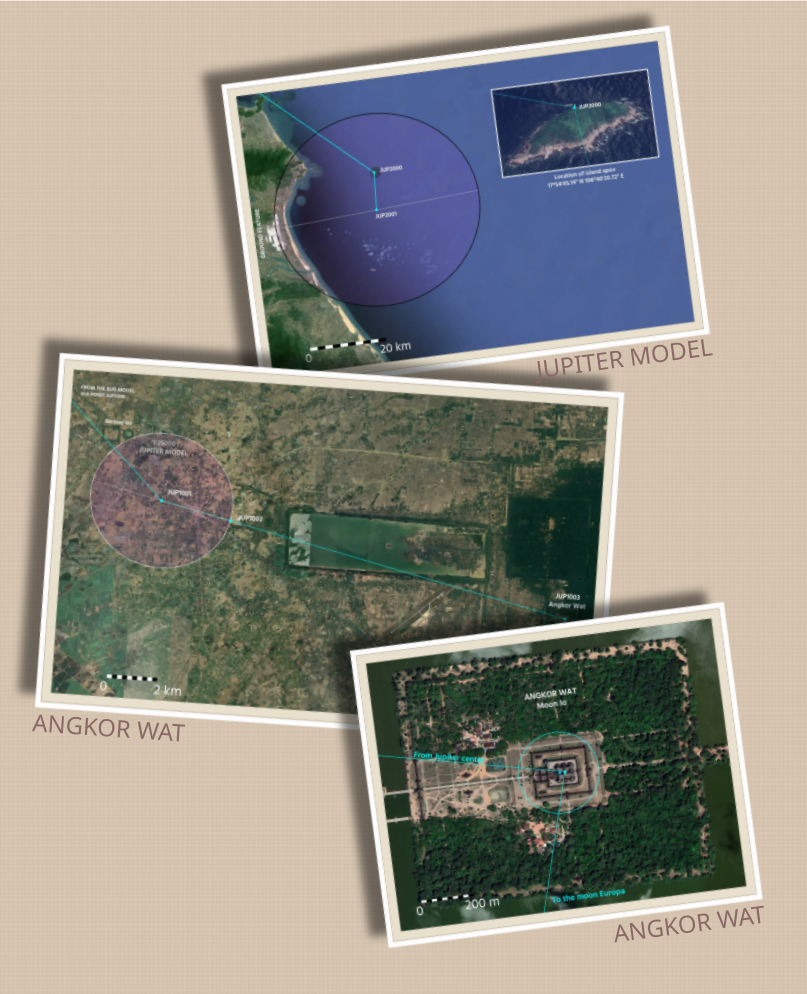
I show that the long term average aphelion and perihelion distances of Jupiter and the range of the planet at the winter solstice of 2729 BCE have been used to locate three models of the planet relative to the Sun model that was identified in the earlier papers. At the location of the perihelion model I show that the first 21 of the moons of Jupiter have been modeled using the temples of the Angkor Wat complex and that the modeling has been done with the knowledge of each moon's orbital characteristics whereby the apoapsis and periapsis values are used with the design system.
I go on to show that there are three more models of the cross section of the planet Jupiter that can be logically uncovered within the design, the smallest being a 1:5000 scale model of the planet and the largest being a 1:600 scale model which is located over central Asia and uses mount Everest to pinpoint its southern pole.
I conclude that the Jupiter models and the moon models must have been constructed using precise and complete knowledge of the Jupiter planetary system.
 Great Pyramid Paper S - The model of Jupiter at Angkor Wat in an ancient solar system model
I show that the long term average aphelion and perihelion distances of Jupiter and the range of the planet at the winter solstice of 2729 BCE have been used to locate three models of the planet relative to the Sun model that was identified in the earlier papers. At the location of the perihelion model I show that the first 21 of the moons of Jupiter have been modeled using the temples of the Angkor Wat complex and that the modeling has been done with the knowledge of each moon's orbital characteristics whereby the apoapsis and periapsis values are used with the design system.
I go on to show that there are three more models of the cross section of the planet Jupiter that can be logically uncovered within the design, the smallest being a 1:5000 scale model of the planet and the largest being a 1:600 scale model which is located over central Asia and uses mount Everest to pinpoint its southern pole.
I conclude that the Jupiter models and the moon models must have been constructed using precise and complete knowledge of the Jupiter planetary system.
DOWNLOAD THIS PAPER - 15.2 Mb
Great Pyramid Paper S - The model of Jupiter at Angkor Wat in an ancient solar system model

ISBN Registered and ©Copyright
The right of Stephen Brabin to be identified as the author of this work has been asserted by him in accordance with the Copyright, Designs and Patents Act of 1998 All rights reserved. No part of this publication may reproduced, stored in or introduced into a retrieval system, or transmitted , in any form, or by any means, (electronic, mechanical, photocopying, recording or otherwise) without the prior written permission of the author. Any person who does any unauthorised act to this publication may be liable to criminal prosecution and civil claims for damages.